Over the last few years, Customer Relationship Management (CRM) systems have evolved from simple contact management tools into powerful, AI-driven platforms that help businesses of all sizes drive revenue, streamline operations, and enhance customer relationships.
What was once a system primarily used by large enterprises is now a game-changer for startups, SMBs, and Fortune 500 companies alike. Sales, marketing, and customer service teams across industries are leveraging CRM solutions to automate workflows, personalize customer interactions, and make data-driven decisions.
Currently, CRM adoption is at an all-time high, with businesses recognizing its role in scaling operations and maintaining a competitive edge. Whether it’s cloud-based CRMs making remote work seamless or AI-powered analytics transforming sales forecasting, the way teams use CRM has fundamentally changed.
What This Article Covers
CRM Market Growth & Adoption Trends – How CRM has become the backbone of modern businesses, with adoption rates skyrocketing across industries.
Why Startups & Enterprises Depend on CRM – The key reasons businesses of all sizes are integrating CRM into their operations.
The Most Valuable CRM Features – The cutting-edge tools and capabilities transforming customer relationship management.
Cloud & Mobile CRM: The New Standard – How remote accessibility and real-time data sync are shaping the future.
How CRM Drives Customer Retention & Revenue – The real-world impact of CRM on business performance and customer loyalty.
Editor’s Choice: Top CRM Stats You Need to Know
- CRM implementation delivers an average ROI of $8.71 for every $1 spent.
- Businesses using CRM see a 29% increase in sales revenue.
- AI-powered CRM tools improve sales forecasting accuracy by 35%.
- Cloud-based CRM solutions dominate, accounting for 80% of the market.
- Companies that integrate mobile CRM see a 14.6% increase in productivity.
- Organizations with CRM automation improve customer retention by 27%.
Key CRM Market Growth Stats
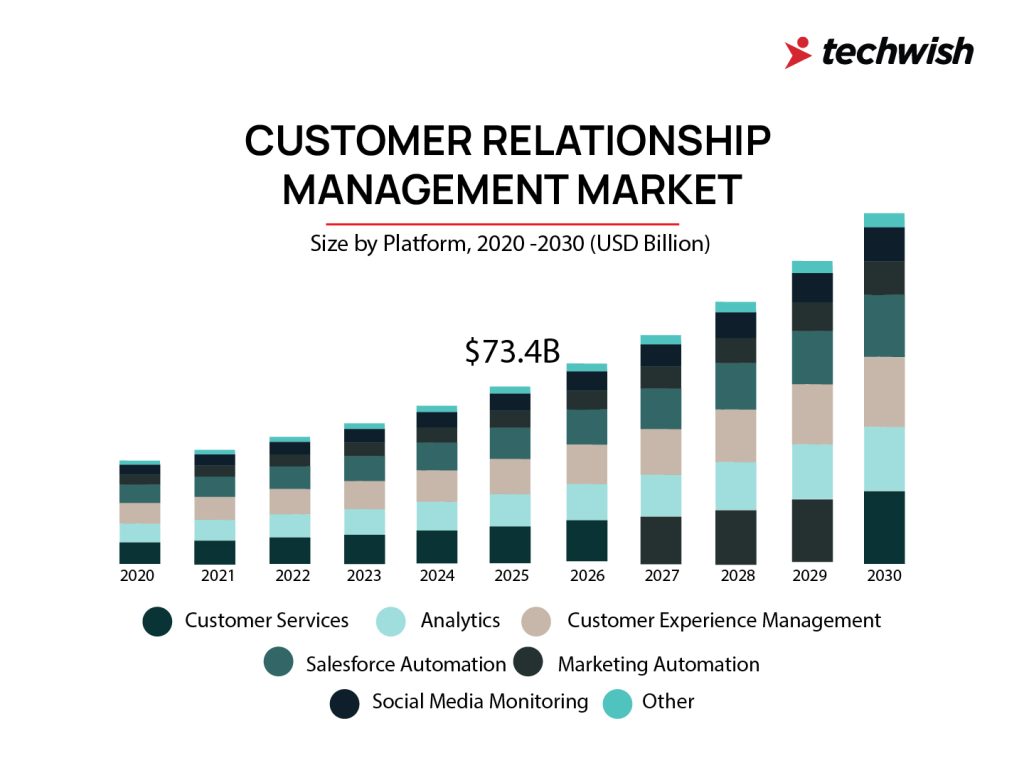
- The global CRM market was valued at USD 73.40 billion, reflecting its rapid adoption across industries.
- With a projected CAGR of 14.6% from 2025 to 2030, the market is set to grow as businesses increasingly invest in AI-driven automation, cloud solutions, and customer engagement technologies. (Source: Grand View Research)
- 91% of businesses with 10 or more employees now use a CRM, a significant jump from just a decade ago. (Source: CRM(dot)org)
- Cloud-based CRM solutions account for over 80% of the market share, indicating a significant shift from on-premise systems to cloud-based platforms.
25% of the enterprise software revenue market was driven by CRM.
- CRM is now the fastest-growing software market, surpassing ERP and HR software in enterprise adoption.
- 73% of sales professionals say CRM helps them close more deals, reinforcing its critical role in revenue generation. (Source: Freshworks)
CRM Usage Statistics: How Businesses Leverage CRM in Daily Operations
- Advanced Features & AI Integration:
- 47% of businesses use AI-driven CRM analytics for predictive insights.
- Workflow automation within CRM improves operational efficiency by 30%.
2. CRM as a Multi-Department Tool:
- While 80% of sales teams use CRM, 46% of customer service teams also rely on it.
- 60% of marketing teams integrate CRM for personalized campaigns.
3. Integration with Other Business Systems:
- 72% of businesses connect CRM with marketing automation platforms.
- 64% of companies integrate CRM with ERP and financial systems.
4. Most Used CRM Features:
- Contact management (94%), task automation (72%), and pipeline tracking (66%) rank as the most frequently used features.
Top CRM Software Features Desired by Buyers
| CRM Software Feature | Percentage of Buyers Wanting It |
| Lead Management | 88% |
| Contact Management | 72% |
| 48% | |
| Reporting & Analytics | 41% |
| Marketing | 32% |
Market Leadership
North America remains the largest regional CRM market globally, driven by strong enterprise adoption.
CRM Adoption Statistics: How Businesses Are Adopting CRM Across Industries
- Adoption Across Different Business Sizes:
- 91% of enterprises use CRM, compared to 50% of small businesses. (Source: Grand View Research)
- SMBs cite cost (35%) and complexity (28%) as the biggest barriers to adoption.
- 43% of businesses use CRM software for easier management. (Source: HubSpot)
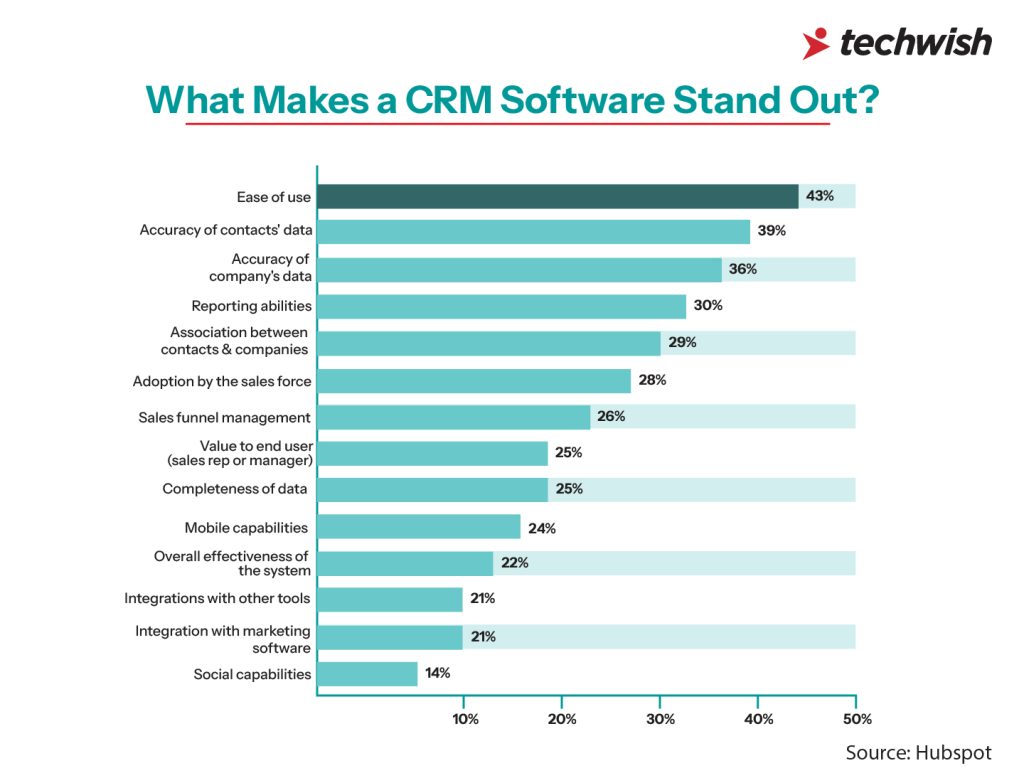
What Makes a CRM Software Stand Out?
| Top Qualities of CRM Software | Percentage (%) |
| Ease of use | 43% |
| Accuracy of contacts’ data | 39% |
| Accuracy of the company’s data | 36% |
| Reporting abilities | 30% |
| Association between contacts & companies | 29% |
| Adoption by the sales force | 28% |
| Sales funnel management | 26% |
| Value to end user (sales rep or manager) | 25% |
| Completeness of data | 25% |
| Mobile capabilities | 24% |
| Overall effectiveness of the system | 22% |
| Integrations with other tools | 21% |
| Integration with marketing software | 21% |
| Social capabilities | 14% |
2. Industry-Specific Adoption Rates:
- CRM adoption is highest in finance (80%), technology (75%), and retail (72%).
- Manufacturing and healthcare trail behind at 55% and 47%, respectively.
3. B2B vs. B2C CRM Adoption:
- 81% of B2B companies rely on CRM, compared to 66% of B2C businesses.
- B2B firms prioritize CRM for lead tracking, while B2C focuses on customer engagement.
4. Cloud vs. On-Premise Adoption Trends:
- 87% of businesses now prefer cloud-based CRM over on-premise solutions.
- Security concerns are the top reason some companies still hesitate to move to the cloud.
5. Growing Investment in CRM:
- 44% of companies plan to increase CRM spending in the next two years.
CRM Usage by Industry
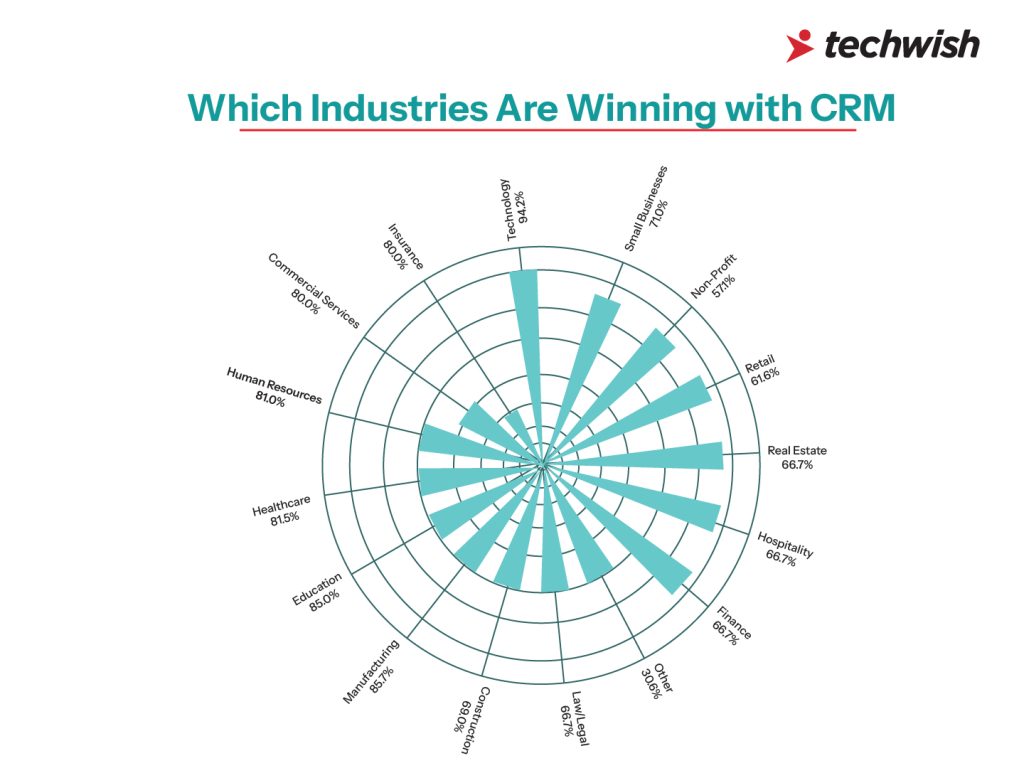
Based on a survey of 600 business owners and professionals in sales, customer service, IT, and marketing.
| Which Industries Are Winning with CRM | |
| Industry | CRM Usage (%) |
| Technology | 94.2% |
| Small Businesses | 71.0% |
| Non-Profit | 57.1% |
| Retail | 61.6% |
| Real Estate | 66.7% |
| Hospitality | 66.7% |
| Finance | 66.7% |
| Other | 30.6% |
| Law/Legal | 66.7% |
| Construction | 69.0% |
| Manufacturing | 85.7% |
| Education | 85.0% |
| Healthcare | 81.5% |
| Human Resources | 81.0% |
| Commercial Services | 80.0% |
| Insurance | 80.0% |
| Consumer Services | 69.4% |
- High Adoption in Technology & Manufacturing
- The technology industry has the highest CRM adoption rate at 94.2%, indicating that tech companies prioritize customer relationship management for growth and efficiency.
- Manufacturing (85.7%) and education (85.0%) also show strong adoption, likely due to the need for streamlined operations, supply chain management, and customer engagement.
- Widespread Use Across Key Sectors
- Several industries, including healthcare (81.5%), human resources (81.0%), commercial services (80.0%), and insurance (80.0%), have adoption rates above 80%.
- This suggests that sectors dealing with large customer bases, client interactions, and compliance benefit significantly from CRM systems.
- Moderate Adoption in Service-Oriented Industries
- Industries like real estate (66.7%), hospitality (66.7%), finance (66.7%), and law/legal (66.7%) show moderate CRM adoption, indicating that while they recognize its value, implementation may vary based on business size and needs.
- Retail (61.6%) and consumer services (69.4%) are slightly lower, which could be due to reliance on other customer engagement tools or in-house management systems.
- Challenges for Non-Profits and Small Businesses
- Non-profits (57.1%) and small businesses (71.0%) have lower adoption rates compared to large enterprises.
- Budget constraints, lack of technical expertise, and alternative tools (like spreadsheets or basic CRM alternatives) might contribute to slower adoption.
- Lowest Adoption in “Other” Category
- The “Other” category (30.6%) has the lowest CRM usage, suggesting that some niche industries may not see CRM as essential or may be using alternative methods to manage customer relationships.
CRM Benefits Statistics
- CRM software can increase sales by up to 29%, improve productivity by 34%, and enhance forecasting accuracy by 42%. (Source: Salesforce)
- Businesses that use CRM software experience a 27% increase in customer retention, as they can better manage relationships and personalize interactions. (Source: Aberdeen Group)
- Companies that integrate CRM with marketing automation see a 14.5% increase in sales productivity and a 12.2% reduction in marketing costs. (Source: Nucleus Research)
- Customer satisfaction rates improve by 47% when businesses implement a CRM, thanks to better communication and faster issue resolution. (Source: Capterra)
- Using a CRM improves data accessibility by 74%, reducing time spent searching for customer information. 79% of leads fail to convert due to a lack of follow-up, but CRM automation increases follow-up efficiency by 32%, helping businesses capture more sales opportunities.
- A Zendesk report reveals that companies recognized as ‘Champions’ in customer experience are 2.1 times more likely than ‘Starters’ to fast-track key CX initiatives, including adopting new channels and enhancing technology investments.
CRM Statistics on Sales Performance: Boosting Sales Efficiency & Conversions
- Sales Productivity Gains:
- Sales reps using CRM tools see a 34% increase in productivity. (Source: Salesforce)
- McKinsey & Company reports that early adopters of sales automation have seen efficiency gains of 10–15%, resulting in more customer-facing time and greater sales opportunities.
- Lead Conversion & Deal Closure Rates:
- CRM users experience a 300% increase in lead conversion rates compared to non-users. (Source: Forrester)
- Companies that integrate CRM with sales processes close 38% more deals. (Source: Aberdeen Group)
- Pipeline & Forecast Accuracy:
- Sales teams using CRM report a 42% improvement in sales forecasting accuracy. (Source: Salesforce)
- Pipeline CRM states that CRM software can reduce sales cycles by 8–14%, with some businesses seeing up to a 53% decrease in deal-closing time.
- Freshworks highlights that a shorter sales cycle accelerates deal closures, cuts sales-related costs, and improves sales ROI.
- Revenue Impact & Customer Insights:
- Salesforce reports that 68% of sales leaders are focused on enhancing pipeline visibility to drive better decision-making. (Source: Forecast(dot)io)
- ChartExpo found that a B2B company leveraged CRM analytics to identify high-potential clients, resulting in a 30% increase in upsell revenue. (Source: ChartExpo)
- Salesforce reports that 65% of field service professionals successfully generate revenue through upselling and cross-selling to existing customers. (Source: Salesforce)
- Collaboration & Sales Alignment:
- Businesses using CRM for sales alignment report a 36% increase in deal size. (Source: WinSavvy)
- Teams that use CRM with AI-powered insights see a 50% improvement in customer response time.
CRM Statistics on Customer Engagement: Enhancing Retention & Loyalty
- Businesses using CRM see a 27% improvement in customer retention rates. (Source: Straits Research)
- Businesses implementing omnichannel strategies see customer satisfaction rates significantly higher, up to 23 times more, according to NewsCred Insights.
- Zendesk highlights that 70% of consumers are willing to spend more with brands that provide seamless, integrated communication experiences.
- Companies that use CRM for customer interactions achieve a 40% faster response time.
- McKinsey & Company reports that 71% of consumers expect personalized interactions, and 76% feel frustrated when this doesn’t occur.
- Personalized experiences powered by CRM lead to a 50% increase in customer engagement. (Source: Harvard Business Review)
- 74% of customers feel frustrated when communications are not personalized, making CRM-driven engagement crucial. (Source: Salesforce)
- Around 80% of companies use CRM data for customer segmentation and targeted marketing. (Source: Grand View Research)
- CRM analytics help businesses identify at-risk customers and improve retention strategies.
- CRM-powered support teams improve customer satisfaction scores (CSAT) by 25%.
- AI-driven CRM chatbots handle up to 70% of customer queries, reducing response time and improving service efficiency.
CRM Statistics on Features: What Businesses Rely on the Most
Most Used CRM Features Across Industries
- 94% of businesses say contact management is the most important CRM feature.
- 72% of CRM users leverage sales automation to streamline lead nurturing.
- Features Driving Business Success
- Businesses using CRM analytics experience a 29% increase in sales revenue.
- 69% of companies report that email marketing automation within CRM significantly improves customer outreach.
- AI-Driven & Automation-Powered Functionalities
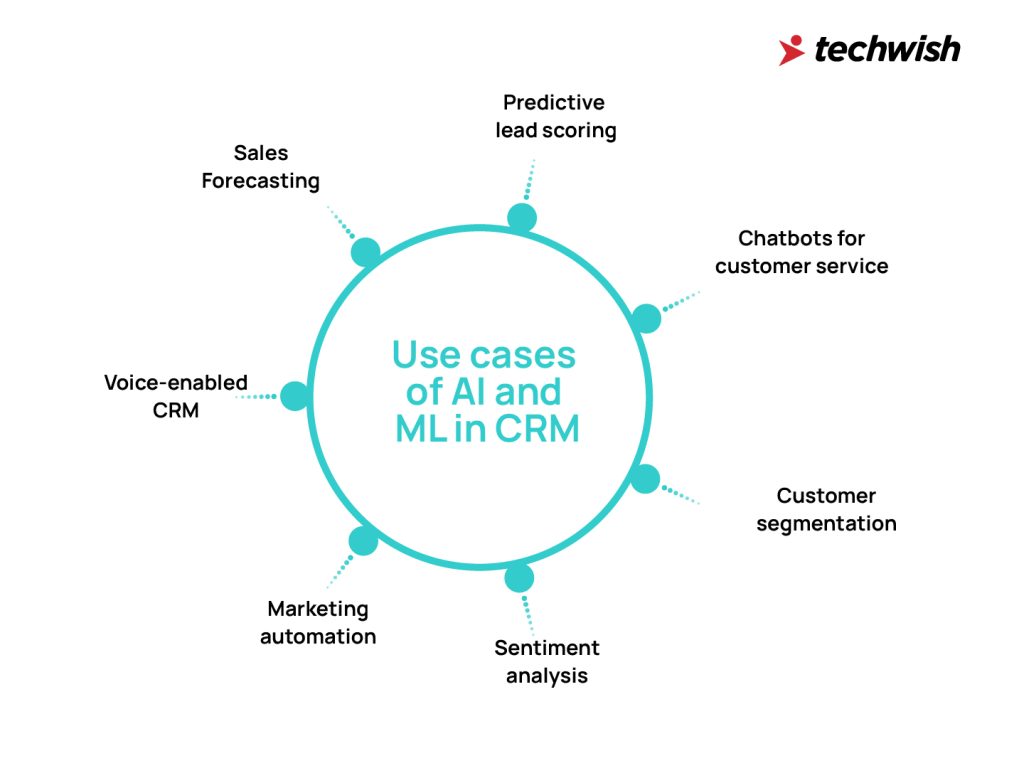
- 84% of CRM users believe AI-powered automation enhances efficiency and reduces manual tasks.
- Customer Support & Service Features
- 79% of customers now expect quicker responses than five years ago, making ticketing systems essential for businesses to stay competitive.
- SaaS and tech companies handle high volumes of user requests, and ticketing systems help streamline, prioritize, and resolve issues efficiently, reducing wait times.
- CRM-integrated chatbots help companies lower customer support expenses by up to 30%.
- Customization & Integration Trends
- Implementing a CRM helped most companies increase their sales revenue by 21-30%.
- Businesses that integrate their CRM with other tools, such as ERP or marketing automation, see a 20% boost in overall productivity.
CRM Statistics on Cloud-Based CRM: The Shift to Scalability & Flexibility
- Cloud CRM vs. On-Premise Growth Trends
- The global cloud CRM market is projected to surpass $80 billion by 2025, reflecting strong growth.
- The cloud-based CRM market is projected to reach $98 billion by 2027, growing at a 14% CAGR.
- Over 70% of CRM implementations are now cloud-based, showcasing widespread adoption.
- High mobile CRM usage among sales professionals is accelerating cloud CRM adoption.
- Small and mid-sized businesses prefer cloud CRM for cost savings and reduced IT overhead.
- Leading cloud providers like AWS, Azure, and Google Cloud offer 99.9%+ uptime, driving adoption.
- Scalability & Security Benefits
- 79% of enterprises cite scalability as the primary reason for migrating to cloud CRM.
- Companies using cloud-based CRM report 30% lower IT maintenance costs compared to on-premise systems.
- Adoption Trends by Business Size
- 84% of SMBs prefer cloud-based CRM for ease of setup and cost efficiency.
- Large enterprises prioritize cloud CRM for its advanced AI and automation capabilities.
- Integration & Remote Accessibility
- 74% of businesses using cloud CRM state that remote accessibility improves workforce collaboration.
- 68% of companies cite seamless integration with other cloud applications as a key advantage.
- Security & Compliance Considerations
- 82% of businesses choose cloud CRM providers based on data encryption and compliance certifications.
- 65% of companies say built-in disaster recovery features in cloud CRM reduce downtime risks.
CRM Statistics on Mobile CRM: Driving Productivity on the Go
- 81% of CRM users rely on mobile access to manage customer relationships.
- Companies using mobile CRM see a 50% boost in sales team efficiency.
- 65% of sales reps with mobile CRM hit their quotas, compared to just 22% without it.
- 75% of businesses report faster customer response times thanks to mobile CRM.
- Nearly half (49%) of CRM interactions now occur on mobile devices.
Top Functions of Mobile CRM
- Real-time access to data
- Seamless customer communication tools
- Automated task and workflow management
- Integration with business applications
- Sales teams leveraging mobile CRM experience a 27% improvement in lead follow-ups.
- 74% of businesses using mobile CRM report higher customer satisfaction.
- 71% of executives say mobile CRM provides real-time insights for quicker decisions.
- Mobile CRM adoption is highest in retail (78%) and financial services (72%).
- Healthcare and logistics are seeing the fastest growth in mobile CRM adoption.
CRM Challenges & Barriers to Adoption
- User adoption struggles: 50% of CRM projects fail due to poor user adoption.
- High implementation costs: 32% of businesses cite cost as a major obstacle.
- Customization complexity: 48% of companies find CRM customization challenging.
- Lack of system integration: 56% of businesses struggle with integrating CRM with existing tools.
- Training issues: 43% of organizations report insufficient training as a key barrier to adoption.
- Data migration hurdles: 38% of companies find transitioning to a new CRM system difficult.
- CRM failure rate: Between 30% and 70% of CRM implementations fail due to poor planning or execution.
- Resistance to change: 22% of employees resist using CRM due to unfamiliarity or complexity.
- Poor data quality: 40% of businesses report inaccurate or incomplete data as a major challenge.
CRM ROI Statistics: Measuring Success
Implementing a CRM system is a significant investment, but how can businesses measure its success? These statistics highlight the key performance indicators (KPIs) and real-world impacts of CRM solutions.
1. Key Performance Indicators (KPIs) for CRM Success
- ROI from CRM implementation averages $8.71 for every $1 spent.
- Companies using CRM experience a 29% increase in sales revenue on average.
- Businesses with a structured CRM strategy improve their customer retention by 27%.
- CRM tools help organizations reduce sales cycle times by 18-22%.
2. Business Case Studies on ROI Improvements
- Companies using CRM automation see a 30% improvement in lead conversion rates.
- Organizations with cloud-based CRM systems report a 15% lower customer acquisition cost compared to those using on-premise solutions.
- Businesses integrating AI into their CRM improve their forecast accuracy by 35%.
3. How Businesses Track and Optimize CRM Effectiveness
- 75% of companies track customer lifetime value (CLV) as a key CRM metric.
- 80% of businesses analyze CRM data to personalize marketing and boost customer engagement.
- CRM adoption is linked to a 40% improvement in team productivity, with better task automation and reporting.
Future of CRM: Trends & Predictions
The CRM landscape is evolving rapidly, driven by AI, automation, and changing customer expectations. Here’s what the future holds for CRM:
1. AI and Automation’s Role in CRM Evolution
- AI-driven CRM is set to grow by 25% annually, enhancing predictive analytics and customer insights.
- Chatbots and virtual assistants will handle up to 85% of routine customer interactions by 2027.
- Automation will streamline workflows, reducing manual tasks by 40% for sales and support teams.
2. The Rise of Customer Data Platforms (CDPs)
- Businesses are shifting toward CDPs to unify customer data across multiple channels, improving personalization.
- By 2026, 70% of enterprises will integrate CDPs with their CRM for better data-driven decision-making.
- Companies using CDPs see a 30% improvement in customer retention and engagement.
3. The Impact of Personalization and Omnichannel Engagement
- Hyper-personalization powered by AI will drive 20% higher customer satisfaction rates.
- Omnichannel strategies will become the norm, with businesses investing in seamless experiences across web, mobile, and social platforms.
- 74% of customers now expect real-time interactions based on past behavior and preferences.
Wrap-Up: CRM’s Evolution Is Just Getting Started
CRM has come a long way, from basic databases to AI-driven, automation-powered ecosystems that shape business strategy. What was once a tool for managing customer contacts is now the central nervous system of sales, marketing, and customer engagement.
The statistics speak for themselves: CRM adoption is at an all-time high, businesses are prioritizing cloud and mobile CRM, and AI-driven insights are transforming how teams connect with customers. But while CRM is more powerful than ever, the real challenge lies in how businesses use it. Simply implementing a CRM isn’t enough; adoption, optimization, and integration determine success.
The companies that will thrive in this era are those that:
✔ Prioritize user adoption and training; a CRM is only as good as how well it’s used.
✔ Leverage AI and automation to move from reactive to predictive customer engagement.
✔ Integrate CRM across all business functions, ensuring a seamless data flow.
✔ Focus on personalization, making every interaction meaningful and customer-centric.
Looking ahead, AI-powered CRMs, hyper-personalization, and predictive analytics will redefine customer relationships. Businesses that embrace these changes will gain a competitive edge, while those slow to adapt may struggle to keep up. CRM isn’t just about managing customers anymore; it’s about future-proofing your business.
Leave a Reply